
How to Choose an HDPE Geomembrane Supplier in the UAE & GCC
Type "hdpe geomembrane supplier" into Google from anywhere in the Gulf and you will find dozens of traders quoting by the square metre. The cheapest quote is rarely the cheapest project. Here is the checklist we advise every buyer to run — whether they order from us or not.
1. Verify the specification, not the brochure
Ask for the actual datasheet against GRI-GM13 (the benchmark standard for smooth and textured HDPE geomembrane) and batch test certificates with each delivery. Key values to compare: thickness tolerance, density, tensile properties, carbon black content (for UV resistance) and stress crack resistance. A supplier who hesitates on certificates is telling you something.
2. Match thickness to the application — not the budget
- 0.75–1.0 mm — irrigation reservoirs, aquaculture ponds, canals.
- 1.5–2.0 mm — landfill cells and caps, leachate lagoons, industrial containment.
- 2.5–3.0 mm — aggressive chemical exposure and heavy mechanical loading.
Textured liner belongs on slopes where interface friction matters; smooth liner suits floors and gentle grades. Our HDPE geomembrane supply page lists the full range we hold.
3. Check roll logistics early
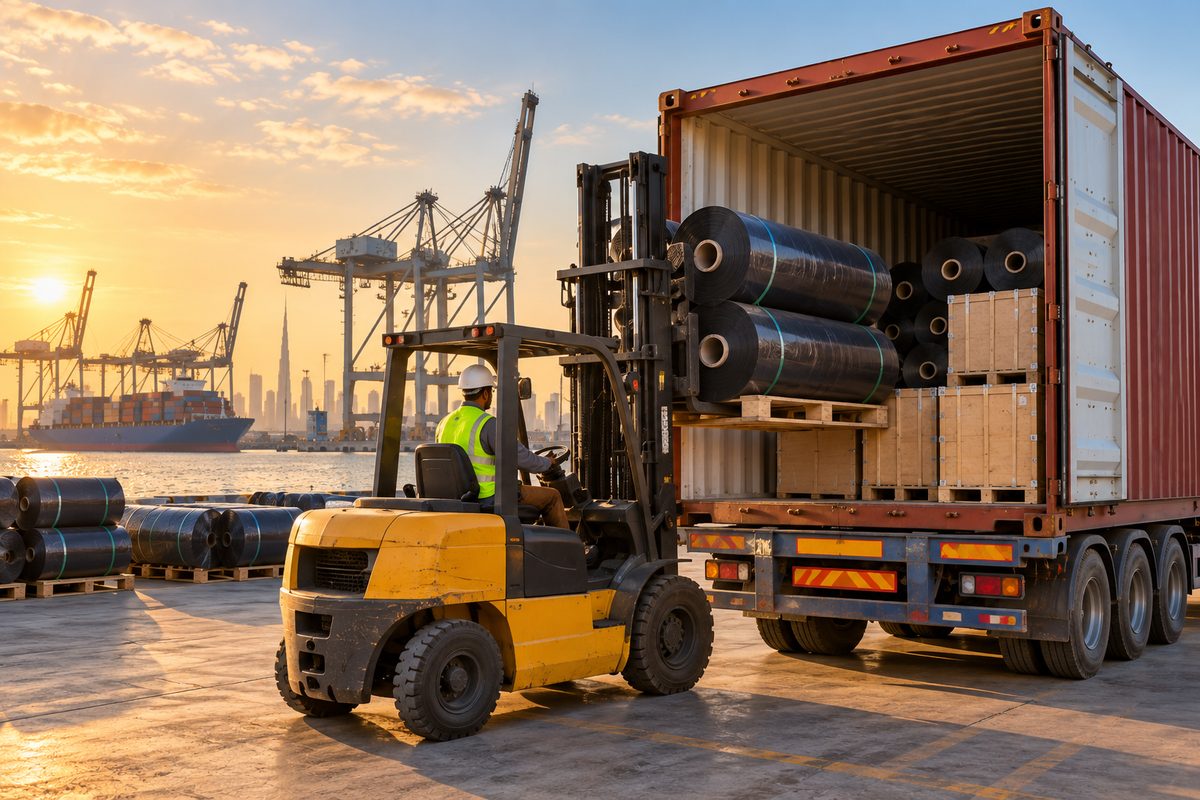
Roll width (7 m standard) and weight decide your crane, transport and panel layout. A supplier familiar with GCC and African deliveries will confirm roll dimensions, port handling and export paperwork before you order — not after the truck is refused at the gate.
4. Insist on welding compatibility
Seams fail when liner resin, welding rod and machine settings come from three unrelated vendors. Confirm your supplier can state which rod grade matches the liner, and ideally supply the wedge welder, extrusion welder and hot air tools alongside the membrane. This single decision is why we structured our business around supplying both.
5. Look past the delivery date
Who answers when a heating element fails mid-project? Where do spare wedges and PTFE shoes come from? Regional stock and a WhatsApp number that replies — ours is +971 50 178 9490 — are worth more than a marginal saving per square metre.
The short version
Certified material, correct thickness, workable rolls, matched welding system, reachable support. Run any supplier — including us — through those five points and your lining project starts on solid ground. For a same-day quotation covering liner and equipment together, contact Infinite Zone FZE LLC in Dubai — and see the complete offering from your HDPE geomembrane and welding machine supplier in UAE.
Reading a geomembrane datasheet properly
Most buyers compare thickness and price and stop there. These are the rows that actually predict how the liner performs in service:
| Property | Why it matters |
|---|---|
| Stress crack resistance (NCTL, ASTM D5397) | Predicts long-term cracking under sustained load. ≥500 hours is the GRI-GM13 benchmark — a low value here fails years after handover. |
| Carbon black content (ASTM D1603) | 2–3% is the UV protection package. Below 2% the liner chalks and embrittles in Gulf and African sun. |
| Carbon black dispersion (ASTM D5596) | Poor dispersion means clumped pigment and weak spots, even when content is correct. |
| OIT (ASTM D3895 / D5885) | Measures antioxidant reserve — effectively the liner's service life in hot climates. |
| Puncture and tear resistance | Survivability during installation, which is when most damage actually occurs. |
| Seam peel and shear (ASTM D6392) | The values your welded seams will be tested against on site. |
Our full datasheet with every value is free to download from the technical library.
Smooth or textured — and where
Textured liner exists for one reason: friction on slopes. The general rule is smooth on floors and gentle grades, textured on slopes steeper than roughly 1V:3H, and double-textured where soil or another geosynthetic sits on both faces. Using textured liner everywhere wastes money and makes wedge welding harder; using smooth on steep slopes risks the liner sliding under load.
Questions to ask before you order
- Which standard does the liner meet, and can you send batch test certificates with delivery?
- Is the resin virgin, and what is the carbon black content?
- What roll width and length — and does my site have the crane and access to handle them?
- Which welding rod grade matches this liner?
- What is the lead time, and what happens if I need additional rolls mid-project?
- Who supports me if a seam fails its QA test?
A supplier who answers all six clearly is worth more than one who is cheaper per square metre. The sixth question in particular separates traders from suppliers — which is why we sell the welding machines alongside the liner rather than only the material.
Comparing more than one supplier
Our comparison of eight HDPE geomembrane suppliers in the UAE is the companion piece to this checklist. It is worth getting at least two or three quotations before committing, particularly on larger projects where roll width and lead time vary more than price does. Alongside our own supply, buyers in the region often compare hdpe geomembrane supplies UAE to benchmark specification and availability before issuing a purchase order.
Storage and handling before installation
- Store rolls on level ground, off the soil, away from sharp stone.
- Keep original wrapping intact until deployment — it is UV protection, not just packaging.
- Never stack rolls more than the manufacturer permits; crushing deforms the core and the liner.
- Deploy in cooler hours where possible; HDPE expands significantly and wrinkles form when hot material is welded tight.
Supplier selection FAQs
Is thicker liner always better?
No. Thickness is chosen for the application and the load, not as a safety margin. Over-specifying makes the liner harder to weld and conform to subgrade, and adds cost without benefit.
What does GRI-GM13 actually cover?
It is the industry specification for smooth and textured HDPE geomembrane, listing minimum values for thickness, density, tensile, tear, puncture, stress crack resistance, carbon black and OIT, with the test method and frequency for each.
Can I mix liner from two suppliers on one project?
It is possible but adds risk: different resins may need different welding settings, and QA documentation becomes harder. If unavoidable, weld and test each batch separately.
How long does HDPE geomembrane last?
Correctly specified and installed, a buried HDPE liner has a design life measured in decades; exposed liner is shorter and depends heavily on carbon black content and antioxidant package — which is why those datasheet rows matter.