
HDPE Welding Rod Guide: Sizes, Grades & How Much to Order
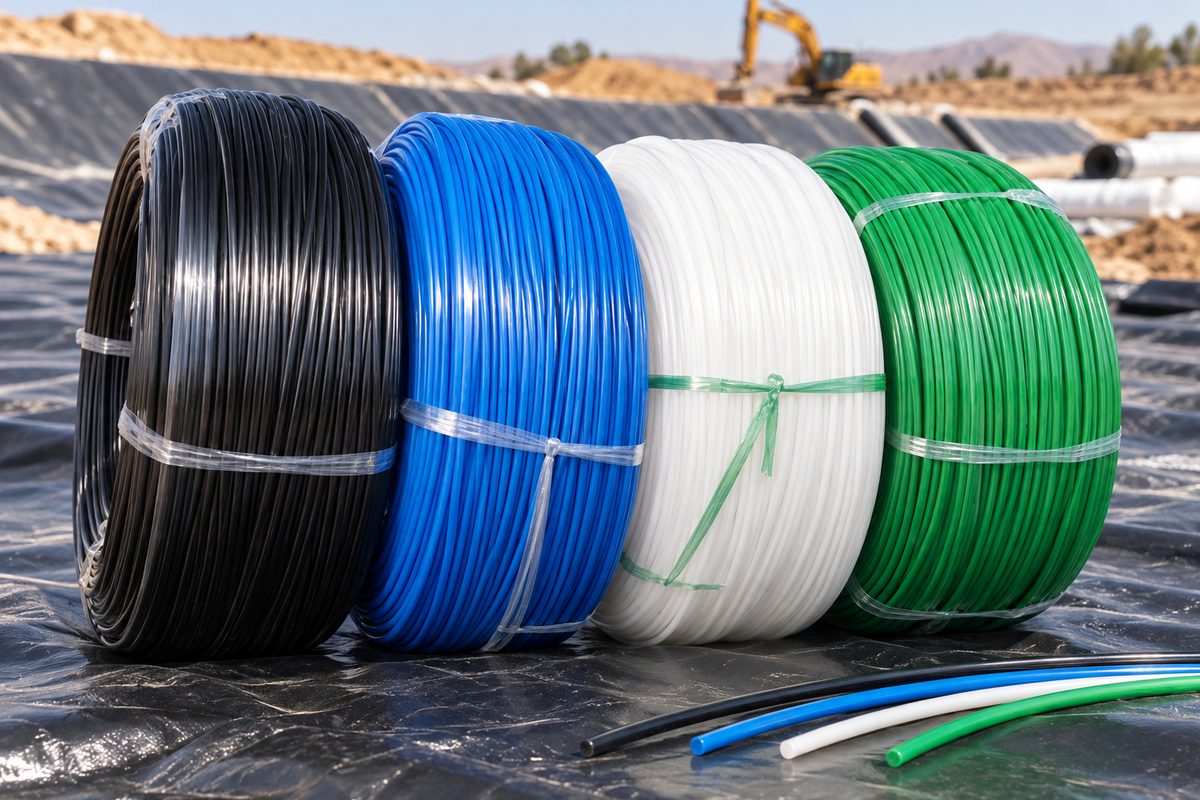
Welding rod is the cheapest item on a lining project and the most common reason seams fail. Wrong grade, wrong size, damp storage — each one shows up later as a failed peel test. Here is what actually matters when ordering rod for an extrusion welding machine.
Rod sizes: 3 mm, 4 mm and when each fits
Hand extruders like our IZ-620 accept round rod from 3.0 to 4.5 mm. Thinner rod feeds easily and suits smaller shoes and detail beads; 4 mm rod (our stock item IZ-4MM-WELD) delivers higher output on long fillet welds and thick-sheet fabrication. Most crews standardise on 4 mm and keep a spool of 3 mm for tight details.
Grade matching beats everything
The rod resin must match the parent sheet: HDPE rod for HDPE geomembrane and sheet, PP rod for PP tanks. Even within HDPE, large differences in melt flow index between rod and sheet cause weak fusion. The safe route is buying rod and liner from the same supplier who has verified compatibility — the reason we ship liner and rod together from Dubai.
How much rod does a project need?
Panel seams are welded by the wedge welder without rod; extrusion rod is consumed by details, patches, penetrations and T-joints. As a budgeting rule, allow roughly 0.3–0.5 kg per 100 m² of installed liner for a normal pond, more for structure-heavy sites — or use our geomembrane & rod calculator for a quick estimate.
Storage and handling on site
- Keep rod sealed, dry and out of direct sun — moisture causes porosity in the bead.
- Wipe rod entering the feeder; dust ends up inside the weld.
- Never mix unlabelled leftover spools between materials.
- Purge the barrel when switching grades or colours.
Need rod with your machine, or a resupply to a GCC or African site? Ask for a quotation — grades matched to your liner, shipped from Dubai stock. Rod, machines and liner together is the whole point of buying from a single welding rod and extrusion welder supplier in Dubai.
Round rod or triangular profile?
Most extrusion work uses round rod in 3 mm or 4 mm. Triangular and flat profiles exist for hot air speed welding of floor and corner joints, where the profile matches the groove shape. For hand extruders, round rod is standard because the drive rollers and feed tube are cut for it — feeding a profile rod into a round feeder causes slipping and inconsistent output.
Colour, and what it does and does not mean
Welding rod is supplied in black, white, grey, blue and green. Colour is pigment, not grade: black rod contains carbon black, which is what gives HDPE its UV resistance, so outdoor and buried work should use black rod unless the specification says otherwise. Coloured rod is used where the weld must be visible for inspection, or to match tank and fabrication colours indoors.
Matching rod to the parent sheet
Three properties matter, in order:
- Polymer family — HDPE rod to HDPE sheet, PP rod to PP. These never cross.
- Melt flow index (MFI) — a large mismatch means one side melts far more readily than the other, producing a weld that looks fine and fails in peel.
- Density and additive package — matters most on specification-driven work such as landfill caps, where the CQA plan may require rod from the same manufacturer as the liner.
If your project specification names the liner manufacturer, ask us for matching rod at quotation stage rather than after delivery — it is usually available, but not always from local stock.
How much rod to order
| Work type | Typical rod consumption |
|---|---|
| Simple pond, few penetrations | ~0.2–0.3 kg per 100 m² |
| Standard lining project | ~0.3–0.5 kg per 100 m² |
| Heavy detail work (sumps, pipes, structures) | ~0.6–1.0 kg per 100 m² |
| Tank / vessel fabrication | Calculate by bead cross-section × seam length |
Always add a contingency — rod is inexpensive compared with the cost of a crew waiting for a delivery. Our calculator produces a quick estimate from your liner area.
Welding rod FAQs
Can I use leftover rod from a previous project?
Only if it is labelled and stored dry. Unlabelled rod is the single most common cause of mystery weld failures — there is no way to tell HDPE from PP rod by eye once the coil wrapping is gone.
Does welding rod expire?
It does not cure or age like adhesive, but it absorbs moisture and picks up dust. Stored sealed, dry and out of sunlight it remains usable for years; stored open on a dusty site it causes porosity within weeks.
Why does my bead look porous or bubbly?
Moisture in the rod is the usual cause, followed by an overheated barrel degrading the polymer. Dry the rod, purge the barrel and re-test before assuming the machine is at fault.
What diameter rod should I choose?
4 mm for general fillet and overlap welding — higher output and fewer rod changes. 3 mm for tight details and smaller shoes. Machines like the Booster EX3 accept both.