
Hot Wedge vs Extrusion Welding for HDPE Geomembrane: Which to Use Where
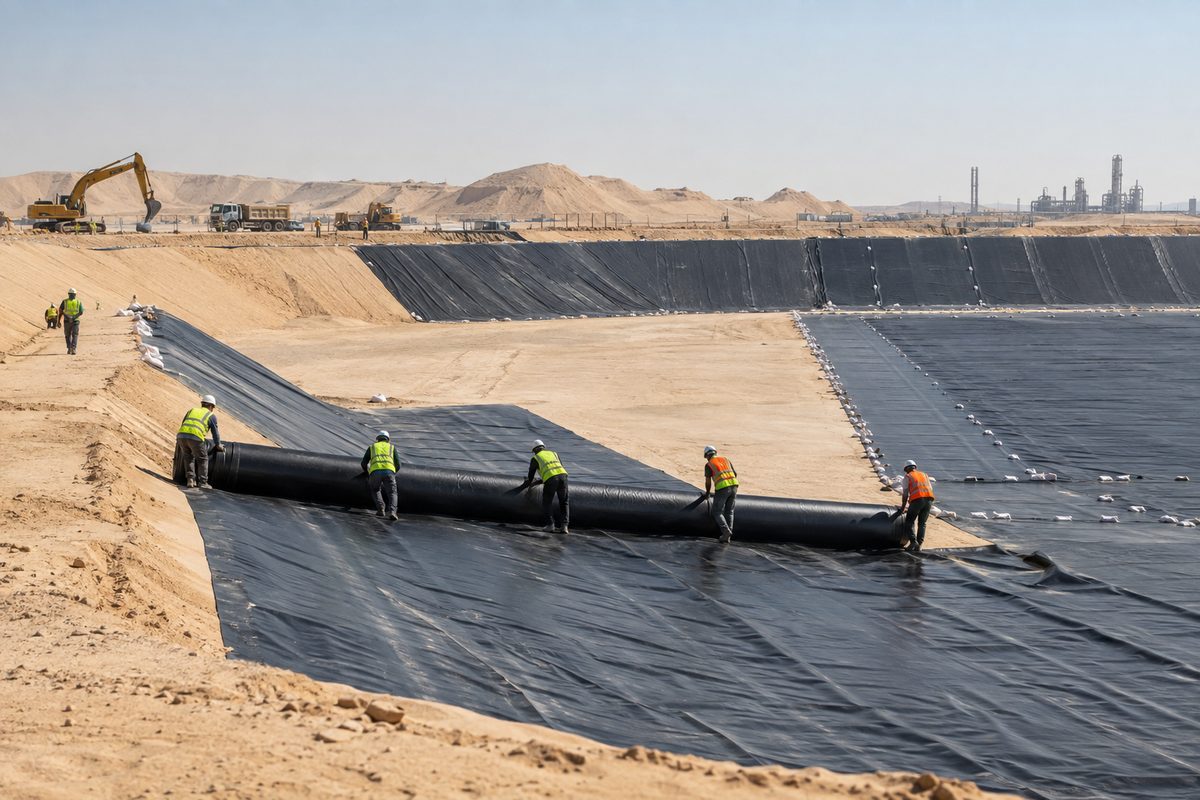
Every serious geomembrane project uses both welding methods — the question is never "which machine do I buy?" but "how much of each seam type does my project have?" Getting that split right decides your crew size, your programme and your QA plan. Here is how the two methods divide the work.
What each machine does
A hot wedge welding machine is a self-propelled unit that drives itself along the overlap of two liner panels, melting the surfaces over a heated wedge and pressing them together between rollers. It produces a dual-track fusion weld with an enclosed air channel between the tracks, at speeds of several metres per minute.
An extrusion welder is a hand-held tool that melts HDPE rod and deposits a molten bead into the joint. It is slower, but it can weld shapes and details no wedge machine can reach — and it adds material, which fusion welding does not.
Where the wedge welder wins
- Long, straight panel seams — the bulk of any pond, landfill or reservoir. Nothing matches its speed and consistency here.
- Testable QA — the air channel between weld tracks is pressurised to prove the seam continuous without destructive sampling of every panel.
- Thin and mid-range liners — from 1.0 mm up to 3.0 mm on machines like our IZ-900.
Where the extrusion welder wins
- Patches and repairs — damage found during installation or after CQA inspection.
- Pipe penetrations, sumps and corners — three-dimensional details where a self-propelled machine cannot travel.
- T-junctions and seam ends — capping the points where wedge seams meet.
- Thick sections and fabrication — attachments, battens and structures welded to the liner.
How each seam is tested
Wedge seams are tested by air pressure in the channel: seal both ends, pressurise, and watch for decay. Extrusion seams are tested by spark (holiday) testing over an embedded conductor or by vacuum box, plus destructive peel and shear coupons at the frequency your specification demands. Your CQA plan should name both methods — consultants in the GCC expect it.
Planning your equipment kit
A typical crew ratio on regional lining projects is one wedge welder supported by one or two extrusion welders, with a hot air gun for tacking panels and positioning patches. Because we supply all three machines plus the HDPE geomembrane itself from Dubai, one enquiry covers the whole kit — matched by material grade so trial seams pass first time.
Planning a lining job in the UAE, Saudi Arabia or Africa? Tell us the area, liner thickness and programme and we will suggest the right machine split and quote it as a package — both machines from one geomembrane welding equipment supplier in Dubai.
Cost and productivity compared
The two methods differ sharply in output, and that difference drives your programme:
- Wedge welding runs at several metres per minute on straight seams. One machine and a two-person crew can close a large pond floor in days.
- Extrusion welding is measured in metres per hour, not per minute, but it is the only option for the work it does.
On a typical pond, roughly 85–90% of the total seam length is wedge-welded panel joints and 10–15% is extrusion work at details, patches and penetrations. If your estimate shows far more extrusion work than that, the panel layout is usually the reason — larger panels mean fewer joints and less handwork.
Consumables and running costs
Wedge welding consumes no filler material at all; its costs are electricity, wedge wear and drive rollers. Extrusion welding consumes rod continuously, plus PTFE shoes and heating elements. Budget both: a project with heavy detail work can use more rod than expected, and running out mid-programme means air freight from Dubai rather than sea.
Which machine handles which liner thickness
| Liner / material | Recommended method | Typical machine |
|---|---|---|
| 0.05–1.0 mm films and thin membranes | Wedge (single track) | Miniwelder Tex1 / Tex2 |
| 0.4–1.5 mm geomembrane | Wedge (dual track) | Miniwelder Geo2 |
| 0.8–3.0 mm geomembrane | Wedge (dual track) | WGW 300 / IZ-900 |
| Details, patches, penetrations, T-joints | Extrusion | Booster EX3 / IZ-620 |
| Tacking and positioning | Hot air | HT1600 / IZ-1600 |
Planning the seam layout before mobilising
Good planning reduces extrusion work, and therefore time and cost:
- Run panels down the slope, not across it, so the wedge welder travels in straight uninterrupted lines.
- Keep seam ends above the waterline wherever the design allows.
- Group pipe penetrations so one crew handles all detail work in a single pass.
- Avoid cross seams in high-stress areas; overlap panels instead.
Sourcing both machines together
Because a lining crew needs a wedge welder and an extrusion welder working side by side, it makes sense to buy them from one source rather than piecing a kit together. Contractors comparing options across the region can also look at geomembrane welding machine supplies when shortlisting, alongside the Weldy range we stock in Dubai.
Seam testing side by side
| Wedge seam | Extrusion seam | |
|---|---|---|
| Non-destructive test | Air pressure in the test channel | Spark test or vacuum box |
| Destructive test | Peel and shear coupons | Peel and shear coupons |
| Speed of QA | Fast — whole seam proven at once | Slower — tested metre by metre |
| Repairability | Cap with extrusion weld | Grind out and re-weld |
Frequently asked questions
Can I complete a lining project with only a wedge welder?
Almost never. Pipe penetrations, patches, seam ends and repairs all require an extrusion welder or, at minimum, a hot air tool. Planning for wedge only usually means renting or buying an extruder mid-project.
Is an extrusion weld weaker than a wedge weld?
Not inherently. Both can achieve film tear bond when set correctly. The difference is consistency: a wedge welder repeats the same conditions mechanically, while an extrusion weld depends more on operator technique.
How many machines does a typical crew need?
One wedge welder, one or two extrusion welders and a hot air gun covers most pond and landfill work. Larger sites add a second wedge machine to keep working when one is down for wedge changes.
What happens if a wedge seam fails its air test?
The channel is isolated in sections to locate the defect, then the failed length is capped with an extrusion weld and retested — which is precisely why both machines belong on site.