
Hot Air Welding Machine Guide: Uses, Nozzles & Technique
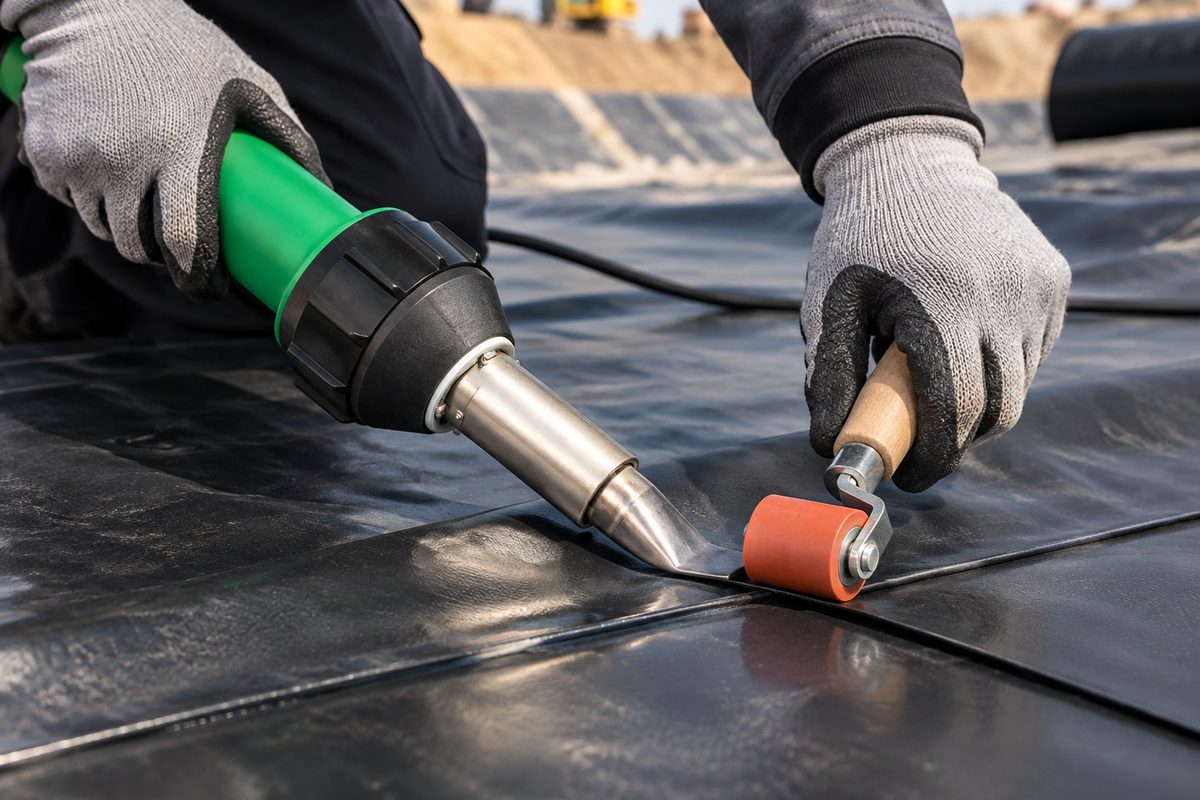
The hot air welder is the most affordable and most versatile plastic welding tool you can own — and also the one most often used badly. This guide covers what a hot air welding machine actually does, which nozzle to fit for which job, and the technique basics that separate a clean weld from a scorched one.
How hot air welding works
A blower pushes air over an electric heating element and out through a nozzle at a controlled temperature — up to about 650°C on tools like our IZ-1600. Directed into the overlap between two thermoplastic sheets, the air softens both surfaces; a silicone pressure roller follows immediately behind, pressing them together so they fuse as they cool. No new material is added — the sheets themselves form the weld.
What a hot air gun is used for
- Tarpaulin and technical fabrics — truck covers, tents, shade sails, banners and inflatables in PVC-coated fabric.
- Roofing membranes — TPO and PVC single-ply overlaps, upstands and flashing details.
- Flooring — welding rod into grooved seams of PVC and linoleum floors using a speed nozzle.
- Geomembrane site support — tack welding panels in position and pre-fixing patches before the extrusion welding machine makes the structural seam.
- General repairs — pool liners, covers, plastic housings and bumpers.
Choosing the nozzle
- Flat overlap nozzle (20 or 40 mm) — the workhorse for membrane and tarpaulin seams; width matches your overlap.
- Pencil nozzle — concentrated heat for corners, patches and awkward details.
- Tacking nozzle — quick spot-fixes to hold panels before final welding.
- Speed welding nozzle — guides welding rod into floor and container seams while preheating the groove.
Technique basics that prevent failures
- Always run a test seam on the day's material and let it cool before peel-testing by hand. Ambient temperature in the Gulf changes settings between morning and afternoon.
- Clean the overlap — dust and moisture are behind most seam failures, not the machine.
- Keep the nozzle moving at a steady angle and speed; scorching means too hot or too slow, a cold peel means the opposite.
- Roll immediately — the roller must follow within a couple of centimetres of the nozzle while the surfaces are still molten.
- Know the tool's limit — thick HDPE structural joints belong to an extrusion welder or wedge welding machine, not a heat gun.
Buying advice
Look for electronic temperature control (not just a dial marked 1–10), stepless airflow, a nozzle range you can actually buy locally, and a weight you can hold all day. The IZ-1600 kit we supply from Dubai ships with roller, nozzles and case — and honest guidance on whether your job needs it alone or as part of a full welding kit. Ask us for a quotation with your application and delivery city, or browse the full tool range from your plastic welding machine supplier in Dubai.
Temperature starting points by material
Every job must be proven with a test weld, but these ranges give a sensible place to begin. Adjust for ambient temperature, wind and material thickness — in Gulf summer conditions the same seam often needs a lower setting at midday than at 7 am.
| Material | Typical starting range | Notes |
|---|---|---|
| PVC membrane / banner | 350–450°C | Scorches easily; keep the nozzle moving |
| TPO roofing membrane | 450–550°C | Needs more heat than PVC; aged TPO needs cleaning first |
| PE / HDPE detail work | 300–400°C | Tacking and patch positioning only |
| PP sheet | 320–420°C | Narrower window than PE — test carefully |
| Coated polyester tarpaulin | 400–500°C | Coating weight changes the setting significantly |
Speed welding with rod
Floor seams, tank linings and container repairs are welded with a speed nozzle that feeds rod and preheats the groove simultaneously. The technique differs from overlap welding:
- Groove the joint to a consistent depth so the rod sits fully below the surface.
- Preheat the groove and feed the rod through the nozzle tube.
- Hold the nozzle at a constant angle — too upright and the rod stretches, too flat and it lifts.
- Keep constant pressure through the nozzle shoe; the rod should mushroom slightly on both sides.
- Trim excess with a spatula knife once cool if a flush finish is required.
Maintenance that extends tool life
- Cool down before switch-off — run at reduced temperature for a minute; abrupt shutdown shortens element life more than anything else.
- Keep the air intake clear — a blocked dust filter starves the blower and overheats the element. Check daily on sandy sites.
- Change carbon brushes in pairs — sparking at the vents or intermittent stopping means they are due.
- Clean nozzles — melted residue changes the airflow pattern and produces uneven seams.
- Never drop the tool hot — the element is ceramic and fractures easily while at temperature.
Spares for the tools we supply are covered in the parts and heating element guide.
Where to buy hot air tools
Hot air welders are sold through plastic welding specialists rather than general tool shops, because the nozzles, rollers and heating elements matter as much as the gun itself. Buyers comparing models locally can also review the range at this hot air gun supplier Dubai, which covers tool selection, kits and accessories in more depth. For the models we stock, see our hot air welding machines.
Safety on site
Hot air tools reach 650°C and look harmless, which is exactly why they cause burns. Use a stand or hanger whenever the tool is set down, keep the nozzle away from cables and membrane offcuts, and allow proper ventilation when welding PVC, which releases irritant fumes when overheated.
Hot air welding FAQs
Can a hot air gun replace an extrusion welder?
No. Hot air fuses surfaces without adding material, so it cannot fill thick joints or build a structural fillet. It complements an extrusion welder rather than replacing it.
Why does my seam peel apart after cooling?
Almost always a cold weld — too fast, too cool, or a dirty overlap. Run a test weld, raise the temperature in small steps and re-test cold each time until the material tears before the seam does.
Which nozzle width should I use?
Match the nozzle to your overlap: 20 mm for narrow laps and detail runs, 40 mm for roofing and tarpaulin seams. A nozzle wider than the overlap wastes heat and scorches the surrounding sheet.
Is a digital hot air tool worth the extra cost?
If your work is process-controlled or documented for QA, yes — digital control with probe feedback repeats the same temperature every shift. For general site work an analogue tool is perfectly adequate. We stock both.