
How to Choose a Heat Gun: Watts, Temperature & What Actually Matters
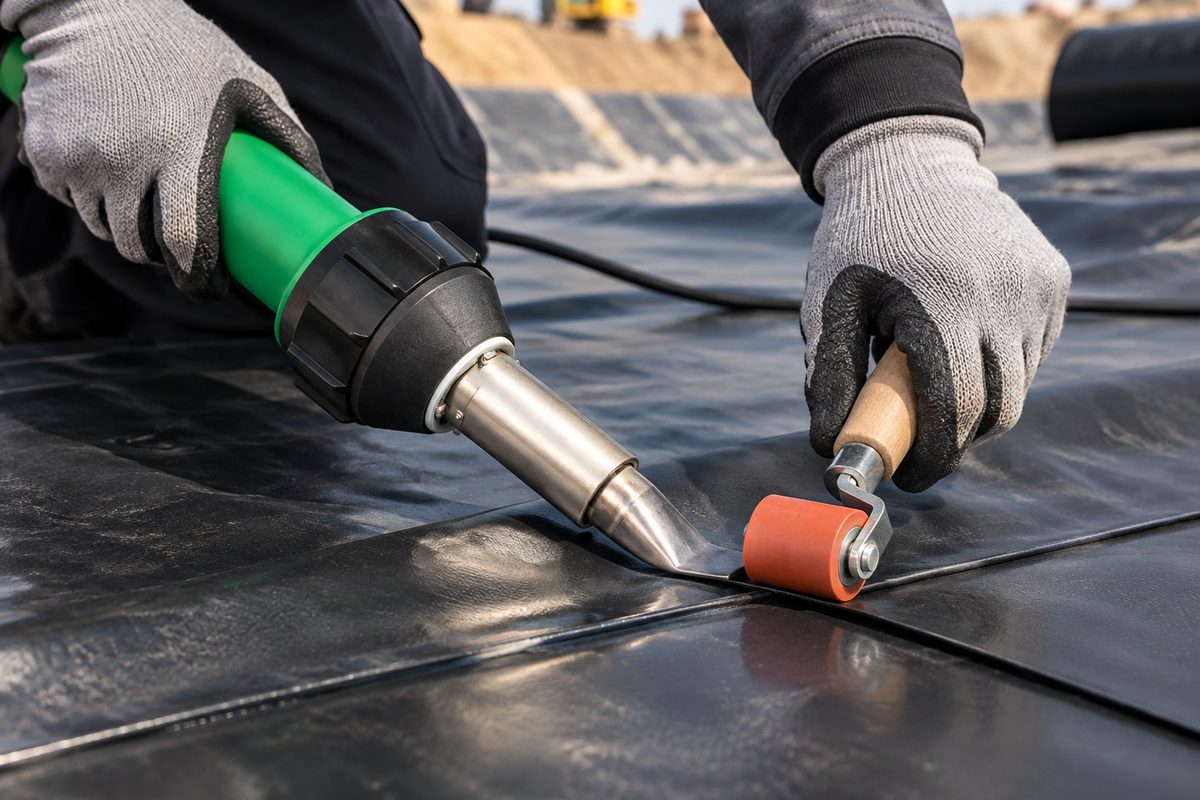
"How many watts is a good heat gun?" and "what is the hottest heat gun?" are the two questions buyers type most — and both point at the wrong spec first. Having supplied hot-air tools to hundreds of crews from Dubai, here is how professionals actually choose.
Watts move air; control makes welds
Wattage (typically 1500–2300 W in professional tools) determines how much air the gun can heat and therefore how wide a nozzle it can drive. A 1600 W tool like the Weldy HT1600 comfortably runs 40 mm overlap nozzles for membrane work. But two 1600 W guns can behave completely differently: what separates them is temperature control quality — a stable element and true variable control across the range.
How hot does it need to be?
Professional guns reach 600–700°C. You rarely weld at maximum: most thermoplastic work happens between 300 and 600°C, and the correct number is always proven by a daily test weld, not read off a chart. What matters is that the gun holds the set temperature under full airflow — ceramic elements do this best, which is why we specify them in our premium line.
The checklist that predicts satisfaction
- Element type and stability — ceramic preferred; ask how the element behaves under continuous load.
- True variable temperature (40–700°C class), not three fixed steps.
- Airflow around 200–250 l/min for membrane and fabric welding.
- Weight — about 1 kg for all-day handheld use.
- Nozzle ecosystem — a standard nozzle seat (31.5 mm) with overlap, pencil, tacking and speed nozzles available locally.
- Serviceable motor — replaceable carbon brushes and a dust filter for sandy sites.
- A supplier who answers — elements and brushes will eventually need replacing; buy where parts live.
Heat gun, wedge welder or extrusion welder?
A heat gun softens and joins thin materials and details. Long geomembrane seams belong to a wedge welding machine; thick structural joints to an extrusion welder. Our hot air welding guide covers nozzle choice and technique once you own the tool.
Still deciding between our value IZ-1600 and the premium Weldy HT1600? Describe your workload — your plastic welding tool supplier in Dubai will answer plainly, with a same-day quotation for the UAE, GCC or Africa.