
Thin Membrane & Film Welding: Machines, Settings and Common Mistakes
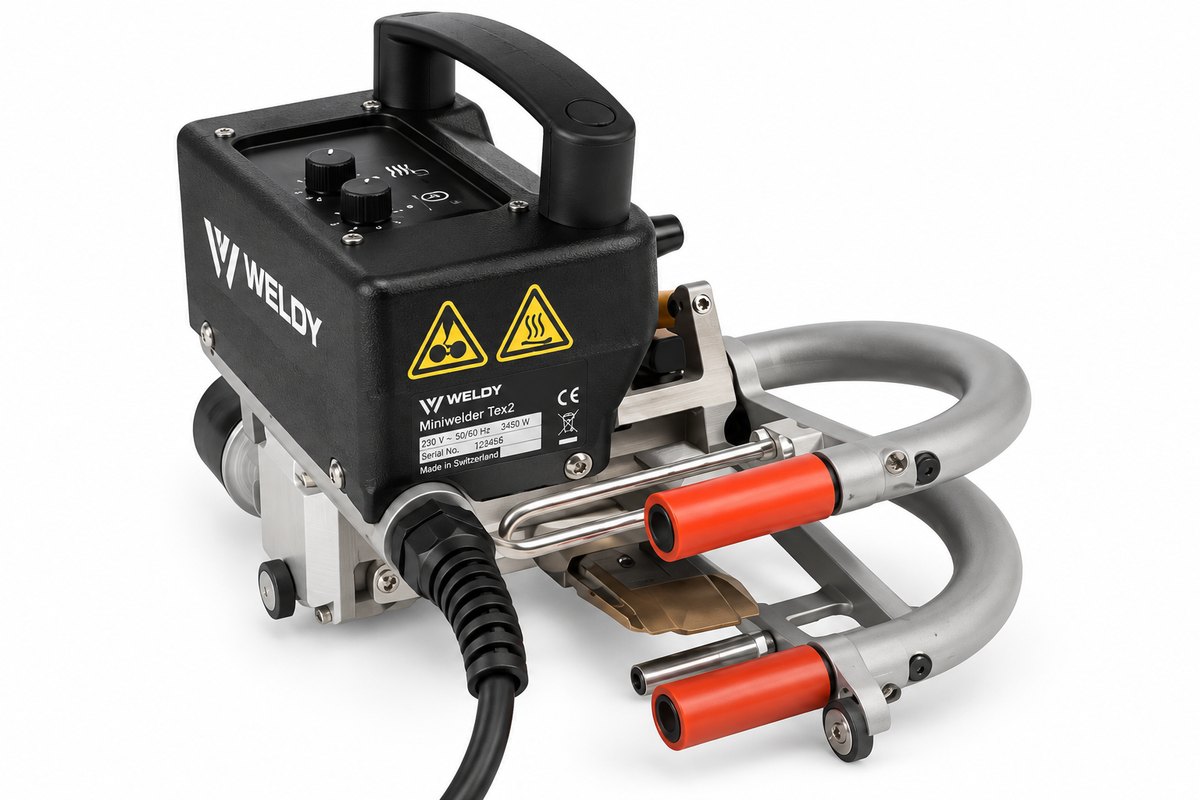
Welding a 0.1 mm greenhouse film is a different craft from seaming 2 mm HDPE liner. Too much heat and the film simply disappears; too little and the seam peels in the first storm. This guide covers the machines and technique for thin-membrane work — greenhouse and agricultural films, pond covers, roofing membranes, tarpaulin and industrial fabrics.
Why thin material needs a different machine
Heavy geomembrane welders carry enough mass and heat to burn straight through thin film. Purpose-built machines solve this in three ways: lower power (300–800 W instead of 1750 W), optimized wedge geometry that contacts the material briefly, and light weight (3.5 kg) so the machine does not stretch the sheet as it travels.
- Miniwelder Tex1 — ball wedge, 300 W, welds from 0.05 mm, 15 mm seam: the specialist for the thinnest foils.
- Miniwelder Tex2 — 800 W, 0.1–1.0 mm, 20 mm seam: the everyday thin-membrane machine.
- Miniwelder Geo2 — when material reaches 1.0–1.5 mm and a dual-track test channel is needed.
Settings: start low, prove with a trial seam
Both Tex machines run 60–480°C at 0.4–7.5 m/min. On thin material, speed protects the sheet: it is usually better to run faster at moderate temperature than slow and hot. Cut two strips of the day's actual material, weld, cool fully and peel by hand — the film should tear beside the seam rather than the seam opening. Re-check after breaks, and remember that ambient heat in the Gulf shifts settings between morning and afternoon (the same discipline as our wedge welder settings guide).
The four mistakes we see most
- Wrong wedge material — PVC needs stainless steel, PE and TPO run better on copper. Mixing them causes sticking and drag marks.
- Tensioned sheet — thin film stretches; feed it relaxed or the seam puckers as it cools.
- Dirty overlap — dust matters more, not less, on thin material: there is less molten mass to absorb it.
- Using a heavy machine "carefully" — a geomembrane welder at minimum settings is still the wrong tool; the right machine costs less than the wasted material.
Sourcing the membrane
Thin films and geomembranes are often bought from different suppliers, which is why welding settings so frequently need re-proving between batches. Buyers sourcing regionally can compare geomembrane suppliers in UAE alongside our own HDPE liner range to keep material and machine matched.
Where a hot air tool fits
Machine seams do the runs; a hot air hand tool handles corners, patches, repairs and anything the machine cannot reach — technique covered in our hot air welding guide.
Not sure which machine suits your film thickness? Full specs sit in the datasheet library, or send us the material and thickness and your membrane welding machine supplier in Dubai will recommend the right one.