
What Is an Extrusion Welding Machine and How Does It Work?
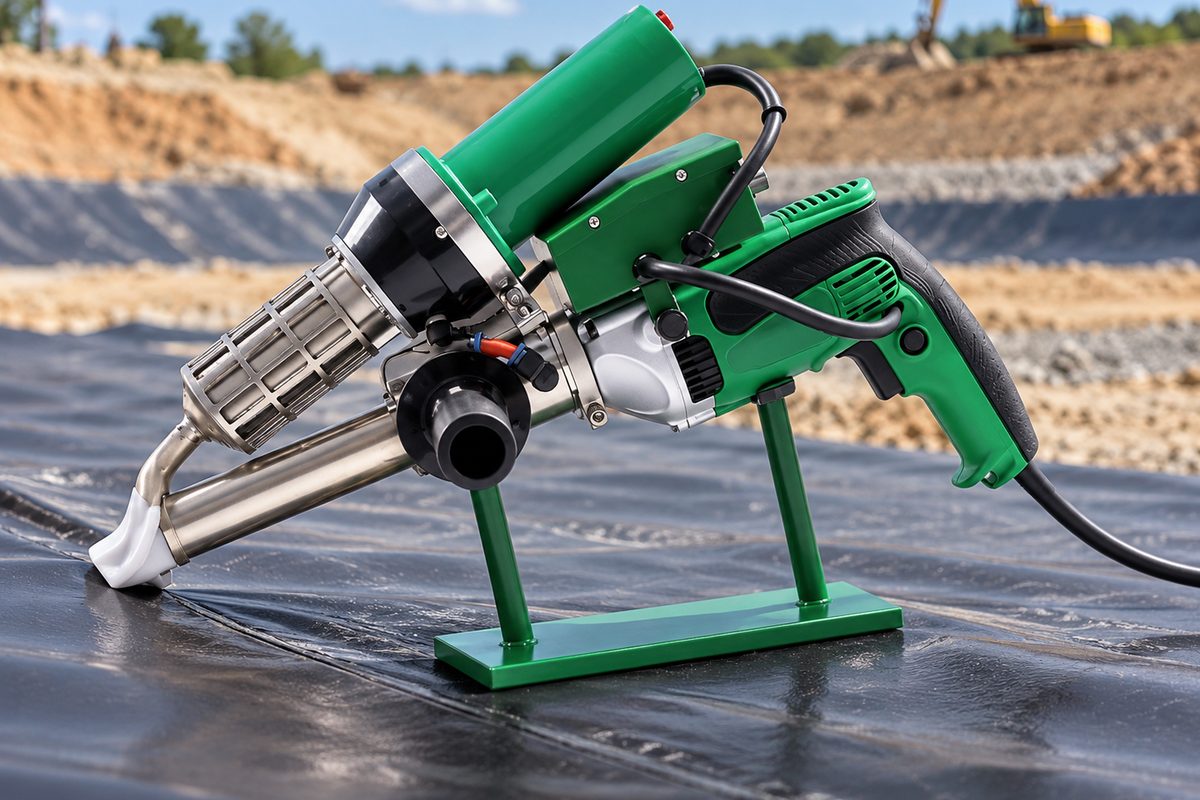
If you fabricate plastic tanks, install geomembrane liners or repair thermoplastic structures, sooner or later a hot air gun stops being enough. That is the point where an extrusion welding machine — also called a hand extruder or extrusion welder — enters the toolkit. This guide answers the questions buyers ask us most often in Dubai and across the GCC.
What is an extrusion welding machine?
An extrusion welding machine is a hand-held tool that produces structural welds on thick thermoplastics by adding new molten material to the joint. Instead of merely softening two surfaces, it feeds a plastic welding rod — usually 3.0–4.5 mm HDPE or PP — into a heated barrel, melts it into a homogeneous mass and pushes the molten bead out through a shaped PTFE welding shoe directly into the seam. A stream of preheated air warms the parent material just ahead of the shoe, so the extruded bead and the base sheets fuse into a single, load-bearing joint.
What is an extrusion machine used for?
- Geomembrane lining works — patches, repairs, pipe penetrations, corners and anchor details on HDPE pond, landfill and reservoir liners.
- Plastic fabrication — welding HDPE and PP sheets into tanks, hoppers, scrubber housings, ducting and custom enclosures.
- Pipework — saddles, fittings and reinforcement beads on thermoplastic pipe systems.
- Heavy repairs — cracked plastic components, container floors, liner damage from machinery or weather.
In short: whenever the joint is thick, structural or three-dimensional, extrusion welding is the method that fills it properly. Our IZ-620 extrusion welder covers exactly this class of work.
What are extrusion guns, and how does the extruder work?
"Extrusion gun" is simply the informal name for the same tool. Inside, four things happen in sequence:
- Rod feed — a motor-driven mechanism pulls the welding rod into the barrel at a controlled rate.
- Plastification — the barrel melts the rod into a uniform molten mass at a precisely regulated temperature.
- Preheating — a hot air stream warms the surfaces of the parent sheets just before the bead arrives.
- Extrusion & shaping — the molten bead exits through the PTFE shoe, which presses and shapes it into the joint as the operator moves along the seam.
Because melt temperature and preheat are controlled separately, a well-set machine produces consistent welds even in the hands of a newer operator — one reason we walk every buyer through trial seams at handover.
Extrusion welding vs hot air and wedge welding
The three methods are teammates, not competitors. A hot air welding gun softens thin materials for detail work and tacking; a hot wedge welding machine closes long geomembrane panel seams at speed; the extrusion welder handles everything thick, structural or awkward that the other two cannot fill. We compare the geomembrane roles in depth in hot wedge vs extrusion welding.
Choosing welding rod
The rod must match the parent material — HDPE rod for HDPE sheet, PP rod for PP — and ideally come from a compatible resin grade. Mixing grades is the most common cause of failed bend tests we see. This is why we supply matching rod, including 4 mm HDPE rod (model IZ-4MM-WELD) with every machine from our Dubai stock, rather than leaving buyers to source it separately.
What to check before buying
- Separate electronic control of melt and preheat temperatures.
- Rod sizes supported (3.0–4.5 mm) and output rate for your seam lengths.
- Availability of PTFE shoes for your joint types — fillet, overlap, corner.
- Local spares and consumables: a machine without rod and shoes nearby is a paperweight.
- A supplier who will demonstrate settings on your actual material.
All five are standard with our supply. If you are weighing up an extrusion welder for HDPE work in the UAE, GCC or Africa, send us your application — material, thickness, location — and we will recommend a configuration and quote the same working day. Everything above ships from the Dubai stock of your extrusion welder supplier in Dubai – UAE.
Which materials can an extrusion welder join?
Extrusion welding works on thermoplastics — polymers that soften repeatedly with heat rather than curing permanently. In practice that means the polyolefin family:
- HDPE (PE-HD) — geomembrane liner, tanks, pipe, manholes. The most common material on our machines.
- LDPE and LLDPE — flexible liners and films used where elongation matters more than stiffness.
- PP (polypropylene) — chemical tanks, scrubbers, laboratory fabrication. Needs PP rod and its own temperature window.
- PVC — possible with the correct rod and settings, though PVC is more often hot-air or solvent welded.
What an extrusion welder cannot join are thermosets and engineering plastics that degrade rather than melt — PTFE, most fibre-reinforced composites, and materials with heavy filler loads. If you are unsure, send us a sample description and we will tell you honestly whether extrusion welding is the right process.
Types of extrusion weld seam
The shape of the weld is set by the PTFE shoe fitted to the machine, and each joint type has its own shoe:
- Fillet weld — the workhorse for T-joints where one sheet meets another at 90°, as in tank corners and baffles.
- Overlap weld — used on geomembrane patches and sheet repairs where one sheet lies over another.
- V-weld and X-weld — for butt joints in thick sheet, where the edges are bevelled and the bead fills the groove. Double-sided (X) welds are specified where full strength is required through the section.
- Corner welds — inner and outer corner shoes for box and channel fabrication.
Keeping two or three shoes per machine is normal practice; a worn shoe produces a rounded, undersized bead long before anything else on the machine fails.
How extrusion welds are tested
Unlike wedge welds, extrusion seams have no enclosed air channel, so they are tested differently:
- Visual inspection — consistent bead width, even wash-out along both edges, no porosity or scorching.
- Spark testing — a conductive wire is laid under the bead during welding; a high-voltage wand then reveals any pinhole as a visible spark.
- Vacuum box — soapy solution plus a vacuum chamber over the seam; bubbles indicate a leak path.
- Destructive coupons — peel and shear samples cut at the frequency the specification demands, tested to confirm film tear bond.
Common causes of a failed extrusion weld
- Oxidised surface — HDPE oxidises within hours; the weld zone must be ground clean and welded shortly after.
- Insufficient preheat — the bead looks perfect but bonds to cold plastic and peels cleanly. The most common invisible defect.
- Mismatched rod — different resin grade or melt flow index to the parent sheet.
- Moisture — damp rod or a damp joint produces porosity through the bead.
- Operator pace — moving faster than the machine's output starves the bead and thins the weld.
Our technique guide covers the temperature and preparation routine that prevents all five.
Extrusion welder FAQs
How long does an extrusion welder take to heat up?
Most hand extruders reach working temperature in five to ten minutes. Never feed rod before the barrel is at temperature — cold starts are the fastest way to damage the drive and the element.
Can one machine weld both HDPE and PP?
Yes, but not without purging. Run the barrel clear of the previous material and change to the matching rod before switching, otherwise the first metre of bead is a blend of two incompatible resins.
What thickness of sheet needs extrusion welding rather than hot air?
As a rule of thumb, above roughly 2–3 mm the joint needs added material. Below that, hot air welding is usually faster and neater. Structural T-joints are an exception — they benefit from an extruded fillet at any thickness.
How much welding rod will a project consume?
Detail and repair work on geomembrane typically uses 0.3–0.5 kg per 100 m² of liner. Fabrication work is calculated from bead cross-section and seam length — our calculator gives a quick estimate.
Do extrusion welders need compressed air?
No. Hand extruders generate their own preheat air with an internal blower, so they only need a suitable power supply — which matters on remote sites where a stable generator is the real constraint.